

You’ve probably heard of Death of a Salesman, but what about the death of a business owner?
A recent post on X described a 42-year-old business owner in the service trades who died unexpectedly. He had a wife, two children, and a company with 15–20 employees.
Like many small business owners, he was deeply involved in the day-to-day decisions—job estimating, management, customer relationships, and more. When he died, his family didn't just lose a husband and father. They also inherited a business they didn't know how to fully operate.
Employees didn't know who would be making decisions. Customers had questions. Contracts needed attention. And his wife was suddenly forced to step into a business she had never run. That's a business continuity problem most business owners don't think about.
Most owners think about an exit plan when they're ready to retire or sell the business. But life doesn't always give us the exit we want or plan for.
Ask yourself:
If You, the Business Owner, Were Suddenly Gone Tomorrow, Could Someone Else Run Your Business?
Could they answer these questions?
- Which jobs are currently in progress?
- Which bids are outstanding?
- Which contracts need immediate attention?
- What commitments have been made to customers?
- Who needs to be paid?
- Who has authority to make decisions?
- Who knows your key customer and vendor relationships?
- Who can authorize payroll?
- Who understands the company's backlog and cash position?
If the answer to most of these questions is “The owner knows,” then you probably have an owner dependency problem.
And that's a problem whether you're planning to exit the business or not. A will or trust can address important questions about ownership and estate planning when someone passes, but it doesn't teach someone how to run your business...
- It doesn't document your estimating process.
- It doesn't tell your employees who is in charge.
- It doesn't transfer the knowledge you've accumulated over the years from running the company.
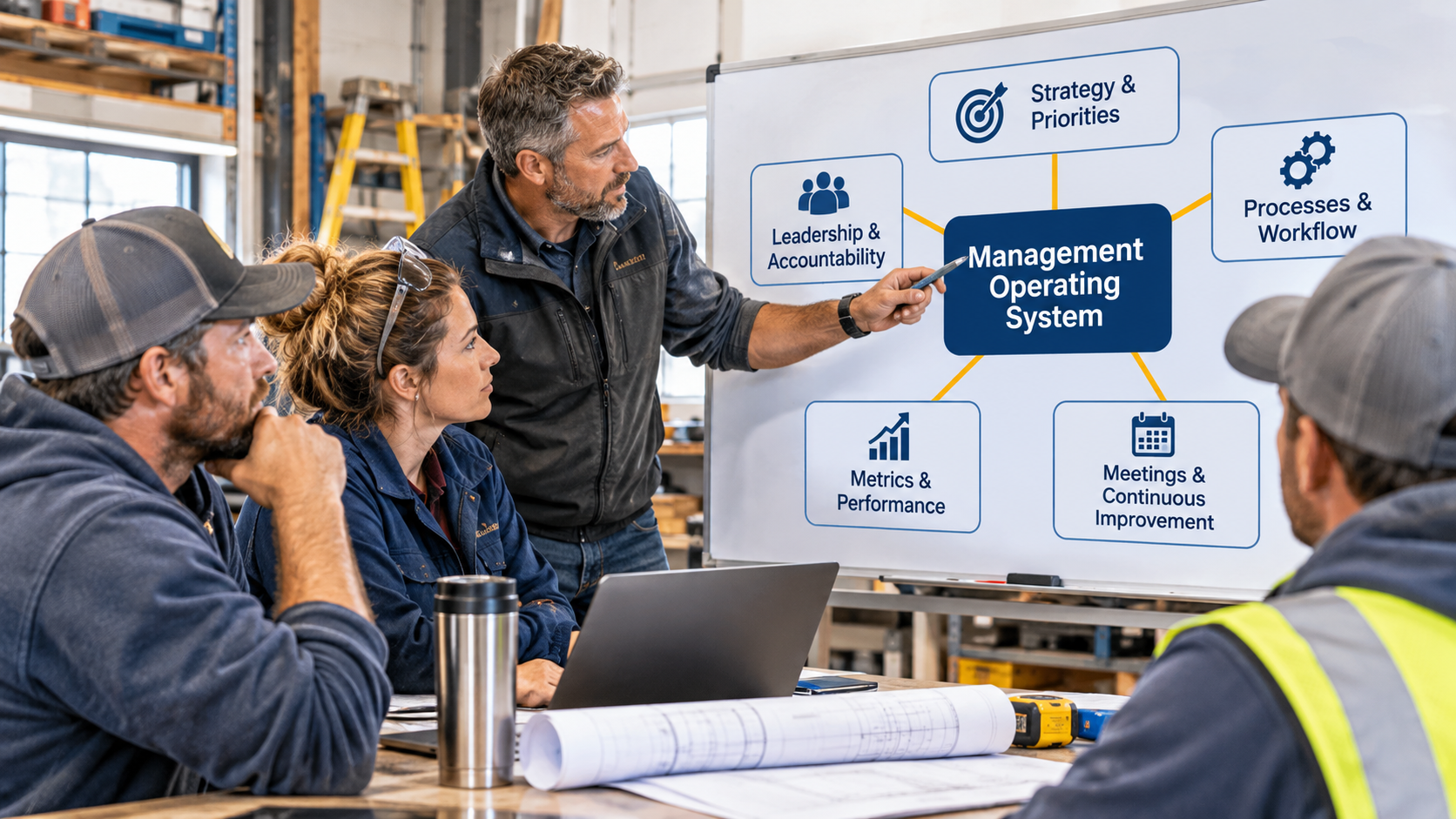
When a Business Owner Suddenly Disappears, the Business Doesn't Just Lose its Owner. It Can Also Lose Its Operating System.
That's why business continuity starts with reducing the number of things that only the owner can do. That means building a business that can operate effectively, efficiently, and resiliently:
Systems — so critical processes don't live only in the owner's head.
Structure — so everyone knows who is responsible for what.
Leadership — so people are capable of making decisions without you.
Accountability — so work continues without the owner constantly stepping in.
And here's the important point:
These aren't just things you need if the worst happens. They're the same things that allow a business to grow beyond its owner. This is where your exit plan and growth plan intersect.
A company that can operate without the owner's constant involvement is also better positioned to grow efficiently. The owner doesn't have to be the bottleneck for every important decision, every customer issue, or every problem that comes up. You may never need your worst-case scenario plan—and hopefully you won't.
But your family, employees, and customers shouldn't have to figure out what happens to your business if you're suddenly unable to be there. You aren't just planning for yourself. You're planning for the people who would have to pick up the pieces.
Build a Business That Can Operate Effectively and Efficiently Without You Always Having to be Involved.
Because building a business that can operate without you isn't just an exit strategy.
It's better business!
At Precision SME, we help small and mid-sized businesses—particularly in the trades—identify where the business is overly dependent on the owner and build the systems, structure, leadership, and accountability needed to move beyond that dependency.