
The employee evaluation landscape has shifted dramatically these days, giving modern businesses an unprecedented variety of assessment options...
personality assessments, behavioral assessments, cognitive assessments, communication assessments, leadership assessments.
Many of them can be useful when used in the right context. But there’s an important distinction that often gets overlooked: not every assessment is designed to measure the same things. An assessment can tell you a lot about how someone thinks, communicates, or behaves. But that doesn't necessarily tell you whether they can effectively perform a specific function, like sales.
More importantly, can it tell you how effectively they sell and what may be getting in the way of better performance? But before going any further let’s take a quick look at two different approaches to assessments.
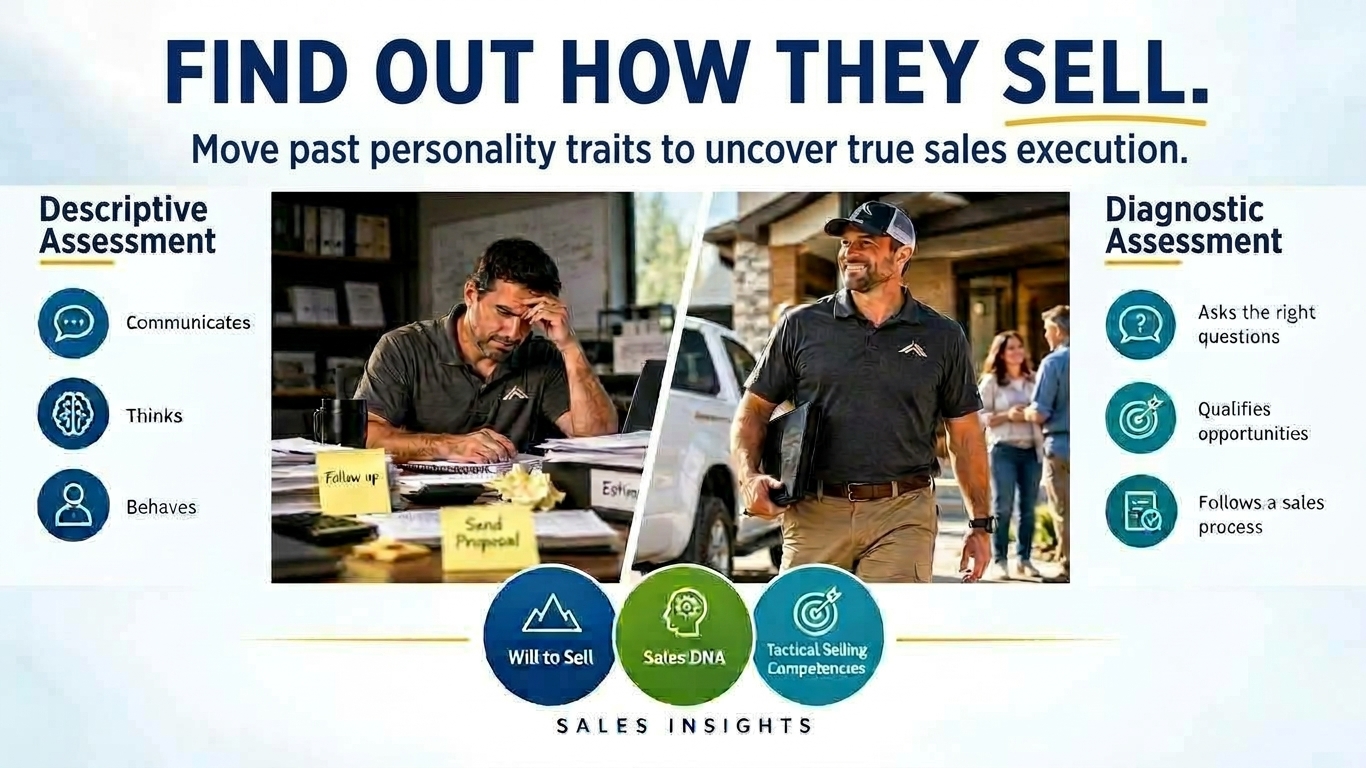
Descriptive Assessments vs. Diagnostic Assessments
Most assessments are primarily descriptive. These types of assessments help explain how someone communicates, processes information, responds to pressure, makes decisions, interacts with others, or prefers to work. They can provide valuable information.
But sales leaders usually need to know something more specific:
Can this person actually sell effectively?
They aren't just asking:
“What is this person like?”
They need to know:
“Can this person consistently execute the behaviors required to sell successfully?”
That is a very different question—and it requires a diagnostic assessment.
A common assumption is that certain personality types are naturally better suited for sales. The outgoing, highly social, extroverted person may seem like the obvious choice, while someone who is quieter or more introverted may be viewed as less likely to succeed.
But personality alone doesn't tell us the whole story.
A salesperson doesn't necessarily need to be the most outgoing person in the room. They need to be able to ask good questions, listen, challenge prospects, discuss money, uncover needs, qualify opportunities, and consistently execute the behaviors required to sell effectively.
In other words, being an extrovert doesn't automatically make someone a great salesperson—and being an introvert doesn't automatically make someone a poor one.
That's why understanding how someone sells can be more valuable than simply understanding what kind of person they are.
That distinction is one of the reasons we use the Sales Insights Report in our sales training and development at Precision SME.
Rather than simply describing someone's personality, Sales Insights is designed around the actual work of selling.
It measures the core areas that influence sales performance and evaluates salespeople across three major areas:
- Will to Sell looks at the drive behind sales performance, including Desire, Commitment, Outlook, Responsibility, and Motivation.
- Sales DNA looks at the underlying beliefs and tendencies that can either support selling or get in the way of it.
- Tactical Selling Competencies focus on the actual work of selling—prospecting, reaching decision-makers, consultative selling, qualifying, selling value, closing, following a sales process, and more.
That changes the conversation and gives businesses a much clearer picture of their salespeople, their strengths, their challenges, and where they may need to improve. Instead of stopping with personality characteristics like outgoing, analytical, assertive, patient, or relationship-oriented, we can dig deeper and look at the sales competencies and skills that can help a salesperson truly excel:
- Can they ask difficult questions without worrying about being liked?
- Can they stay present and listen instead of thinking about what they're going to say next?
- Can they talk about money comfortably?
- Can they challenge a prospect who says they want to “think it over”?
- Will they make the effort to reach the real decision-maker?
- Will they fully qualify an opportunity before putting together a proposal?
These are the sales competencies and skills that can make the difference between average sales performance and top sales performance.
Does the Diagnostic Assessment Relate to Real-World Sales Performance?
A 2026 criterion-validity study involving more than 3,000 active salespeople looked at whether the Sales Insights assessment results actually lined up with real-world sales performance.
Researchers compared assessment results with several measures of job performance, including company performance ratings, win rates, pipeline opportunities, and contribution to team revenue.
The results showed a statistically significant relationship between all three major areas and sales performance, with tactical selling competencies showing the strongest relationship.
Of the candidates who were recommended and then hired, 72% became top-half performers within 12 months.
None of the not recommended candidates who were hired reached the top half.
First-year turnover was also significantly lower among recommended candidates—9% compared with 33% among not recommended candidates. That’s a very different use of an assessment than simply understanding someone’s personality.
It’s about using assessment results to help make better decisions.
Predictive Is Valuable. Actionable Is Even Better.
For us at Precision SME, one of the biggest benefits of the assessment is what happens after you get the results of the assessment.
A useful sales assessment shouldn’t end with: “Interesting. Now we know what Andrew is like.”
It should lead to: “Now we know what Andrew needs to work on.”
For example, suppose the report identifies a weakness around discussing money. That gives us something specific to work on.
We can look at how the salesperson introduces the subject of budget, what questions they ask, how they respond when a customer pushes back, and whether they’re actually uncovering the financial information needed to properly qualify the opportunity.
Or maybe the issue is need for approval.
That could help explain why a salesperson avoids challenging a prospect, accepts vague answers, fails to reach the decision-maker, or backs away from difficult questions.
Or perhaps they have strong selling skills but weak commitment.
In that case, more over the counter, off the shelf sales technique may not be the answer. This is where Sales Insights becomes particularly valuable.
It helps us distinguish between skill gaps, underlying beliefs, behavioral obstacles, motivation issues, and execution problems.
And those findings can be turned into something a manager can actually use:
- Coaching conversations
- Role-playing
- Field observation
- Practice
- Follow-up
For example, the "Consultative Selling" competency looks at a salesperson’s ability to actively listen and ask relevant, challenging, timely questions that uncover compelling reasons to buy.
"Qualifying" looks at whether they uncover budget, understand the decision-making process, discuss finances, and identify what could derail the opportunity.
Those aren’t abstract personality traits. They’re sales skills that can be observed, coached, practiced, and improved.
Why and How Precision SME Uses Sales Insights
At Precision SME Group, the Sales Insights evaluation is a cornerstone of our sales training and development program.
We use it in three primary areas:
- Hiring: It gives us another source of information beyond the resume and interview.
- Training: It helps us understand where each salesperson is starting. Two people can sit through the exact same sales training and need completely different things from it.
- Development: It gives managers a roadmap for ongoing coaching.
That matters because training shouldn’t simply transfer information. Knowing what good selling looks like and being able to execute it consistently are two different things.
A good assessment helps identify the gap between the two.
Sales Insights doesn’t just describe a salesperson.
It helps us understand what may be helping them sell, what’s getting in their way, what they need to work on next, and how long it will take to resolve any issues.
For a sales leader trying to hire better people, improve performance, or develop an existing team, that’s a much more useful place to start.
If you’re trying to determine whether your sales team has the skills, mindset, and behaviors needed to perform at a higher level, let’s take a closer look at what your people are actually doing—not just what their personality tells you about them.
Contact Precision SME to learn how we use Sales Insights to help you identify sales strengths, uncover performance obstacles, and build a more targeted plan for hiring, training, and development.