
Every Stage of Growth Requires a Different Version of the Business
One of the biggest mistakes business owners make is assuming that growth simply means doing more of what already works.
More customers. More employees. More revenue. More projects.
Unfortunately, growth doesn't work that way.
As businesses grow, they evolve. New challenges emerge, leadership requirements change, and operational complexity increases.
What worked at $500,000 often fails at $2 million. What worked at $2 million frequently breaks at $5 million. And what worked at $5 million may become a major obstacle at $10 million and beyond.
The organizations that scale successfully understand an important truth.
Every stage of growth requires a different business.
Not a different company.
A different way of operating.
Why Businesses Hit Growth Ceilings
Many businesses eventually reach a point where growth slows. The owner becomes frustrated, the team feels overwhelmed, profitability becomes inconsistent, and the organization struggles to move forward.
Owners often assume they simply need:
- More marketing
- More sales
- More employees
- More customers
Sometimes that's true.
More often, however, the real issue is that the organization has outgrown its current structure.
The business is trying to operate at a higher level using systems that were designed for a much smaller company.
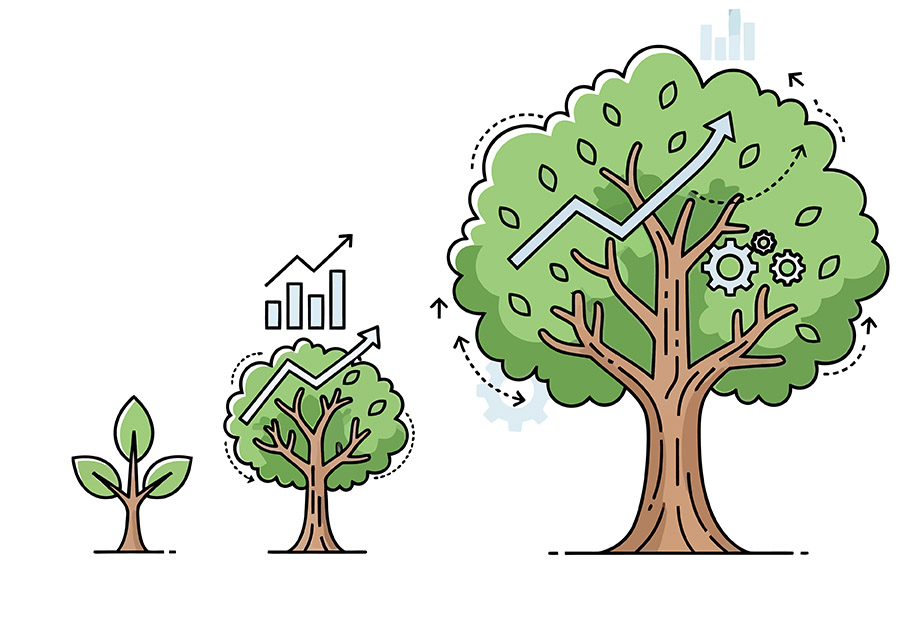
And evolution happens in stages.
Stage 1: The Startup Stage
"I'll Do Whatever It Takes"
Every business begins somewhere, and this is where most start.
The owner handles sales, operations, customer service, scheduling, estimating, finance, marketing, and leadership. Nearly every important responsibility flows through one person.
In the beginning, that's often necessary.
The organization is small, resources are limited, and speed matters more than efficiency.
Characteristics of Stage 1
- Owner-centered decision-making
- Limited organizational structure
- Informal processes
- Minimal leadership layers
- High flexibility
- Heavy reliance on individual effort
The objective at this stage is survival.
Generate revenue. Build a customer base. Create momentum.
Common Challenges
As the business grows, the startup model begins showing its limitations.
The owner becomes overwhelmed, employees require more direction, communication becomes more difficult, and processes start producing inconsistent results. Customer expectations continue rising while the business struggles to keep up.
These are often the first signs that the company has outgrown its startup operating model.
What Must Change
Moving beyond Stage 1 requires more than hiring additional people.
The organization needs basic structure, clearly defined roles, standardized processes, delegation, and leadership development.
Most importantly, the owner must begin shifting from being the primary producer to becoming the leader of the organization.
That transition is rarely comfortable.
But it's essential.
Stage 2: The Managed Growth Stage
"We're Growing Faster Than We Can Manage"
This is where many businesses spend the majority of their journey.
Revenue continues increasing. More employees are hired, more customers are served, and the organization becomes significantly more complex.
The challenge is that complexity often grows faster than management capability.
Characteristics of Stage 2
- Multiple departments emerge.
- Leadership positions are added.
- Communication becomes more challenging.
- Operational systems become increasingly important.
- Accountability becomes more critical.
- Owner involvement remains high.
This stage often feels chaotic.
The business is growing.
So are the growing pains.
Common Challenges
Organizations in this stage frequently experience:
- Leadership gaps
- Communication breakdowns
- Accountability issues
- Process inconsistency
- Owner bottlenecks
- Pressure on profitability
Many owners feel trapped.
The business is successful on paper, yet it demands more time, energy, and attention than ever before.
What Must Change
To move beyond Stage 2, organizations must build capacity instead of simply adding people.
That means investing in:
- Leadership systems
- Organizational structure
- KPI scorecards
- Leader Standard Work
- Continuous Improvement practices
- Clearly defined accountability
The focus begins shifting from managing people to managing systems.
That's where true scalability begins.
Stage 3: The Scalable Enterprise Stage
"The Business Operates Through Systems"
At this stage, the business becomes increasingly independent of ownership. The owner remains important, but the organization no longer depends on their constant involvement to function effectively.
Leadership exists throughout the company. Systems create consistency, decision-making is distributed, and the business gains the stability needed to support long-term growth.
Characteristics of Stage 3
- Strong leadership team
- Defined organizational structure
- Clear accountability
- Standardized processes
- KPI-driven management
- A culture of Continuous Improvement
Because the organization has developed the capacity to support growth, growth no longer creates chaos.
Common Challenges
The challenges don't disappear.
They simply change.
Instead of focusing on day-to-day survival, leadership begins concentrating on strategic growth, succession planning, leadership development, organizational alignment, and long-term value creation.
The conversation shifts from surviving growth to optimizing performance.
What Must Continue
Reaching this stage doesn't mean the work is finished.
Organizations must continue investing in leadership development, process improvement, strategic planning, organizational design, and Continuous Improvement. Growth never stops requiring evolution, and organizations that stop evolving eventually stop growing.
Why Some Businesses Get Stuck
Many businesses never successfully transition from one stage to the next because they continue operating as if nothing has changed.
Startup leadership is applied to a growth-stage company. Growth-stage systems are expected to support a mature organization.
The result is predictable.
Performance slows.
Growth stalls.
Owners become frustrated.
The business becomes trapped.
The organizations that continue growing are willing to evolve as their businesses evolve.
How to Identify Your Stage
A few simple questions can help determine where your business is today.
Startup Stage
Does most decision-making still flow through the owner? Are processes largely informal? Is ownership directly involved in nearly every aspect of daily operations?
If so, you're likely in Stage 1.
Managed Growth Stage
Have leadership positions emerged? Is communication becoming more challenging? Does growth seem to create more complexity and stress than freedom?
If so, you're likely in Stage 2.
Scalable Enterprise Stage
Can the business operate effectively without constant owner involvement? Are systems driving performance instead of personalities? Is leadership distributed throughout the organization?
If so, you're entering Stage 3.
The Goal Is Not Growth Alone
Many business owners focus almost exclusively on revenue.
Revenue matters.
But growth without organizational development eventually creates chaos.
The real objective is building an organization with strong leadership, clear accountability, effective systems, a commitment to Continuous Improvement, and sound financial discipline.
That's what creates sustainable success.
The Business Impact
Organizations that understand the different stages of growth often experience:
- Better planning
- Stronger leadership development
- Improved organizational design
- Reduced owner dependency
- Better decision-making
- Greater scalability
- More sustainable profitability
Perhaps most importantly, they stop being surprised by growth challenges.
They begin anticipating them.
Final Thoughts
Every business goes through stages.
Each stage creates new opportunities. Each stage introduces new challenges. And each stage requires a higher level of leadership, structure, and organizational capability.
The businesses that thrive aren't necessarily the fastest growing.
They're the ones that continue evolving as they grow.
Because success at one stage doesn't guarantee success at the next.
The systems that got you here may not get you where you want to go.
The question every business owner should ask is simple:
What stage is my business in today—and what must change for us to reach the next one?
The answer may unlock your next phase of growth.
How to Scale Without Losing Control
Growth Should Create Freedom, Not More Stress
For many business owners, growth starts out exciting.
Revenue increases. The phone rings more often. The team expands, opportunities multiply, and the business appears to be moving in the right direction.
Then something changes.
Communication becomes more difficult. Problems become more frequent. Employees require more direction, customers begin experiencing inconsistencies, and profitability becomes harder to maintain.
The owner finds themselves working more than ever.
Eventually, a troubling question emerges:
"If growth is supposed to be success, why does everything feel harder?"
The answer is simple.
Many businesses grow.
Few businesses scale.
And there is a significant difference between the two.
Growth and Scalability Are Not the Same Thing
Growth means becoming larger.
Scalability means becoming more capable.
A business can increase revenue while becoming less efficient. It can add employees while becoming more dependent on ownership. It can generate more sales while becoming less profitable.
Growth alone doesn't guarantee improvement.
Scalability occurs when the organization can handle additional volume without proportional increases in complexity, stress, or owner involvement.
That's the real objective.
Not simply becoming bigger.
Becoming stronger.
Why Growth Often Feels Like Losing Control
Most business owners build their companies through direct involvement.
They make decisions, solve problems, manage customers, oversee operations, and maintain quality. That approach works well when the business is small.
As the organization grows, however, complexity grows with it.
There are more employees, more customers, more projects, more decisions, and more communication. Eventually, no single person can effectively manage everything.
The systems that once worked begin breaking down.
Owners often feel like they're losing control—not because they're doing less, but because there is simply too much to manage the old way.
This is where many growing businesses reach a crossroads.
Ready to Build a Business That Can Keep Growing?
Every growing business reaches a point where the systems, leadership and processes that got it this far are no longer enough to support the next stage of growth. The sooner you recognize those limits, the easier they are to overcome.
At Precision, we help business owners identify the organizational bottlenecks that are slowing growth and build the structure, leadership and accountability needed to scale with confidence. Whether your biggest challenge is communication, operational efficiency, leadership development or creating systems that reduce owner dependency, we'll work alongside your team to build an organization that's stronger, more profitable and prepared for what's next.
Contact us today to get the conversation started.