

Is Your Organizational Structure Holding You Back?
Many contractors don't intentionally design their organizational structure. Instead, it evolves as the business grows, often without much thought given to how roles and responsibilities need to align.
A helper gets hired. Then a technician. An office administrator follows, then another technician, a project manager, and eventually more employees. Before long, the company has 15, 20, or even 30 employees. Yet the organizational structure hasn't kept pace with the growth in people, responsibilities, and workload.
The business remains dependent on the owner—everyone reports to the owner, important decisions flow through the owner, and problems land on the owner's desk. The result is an organization that relies on one person to keep nearly everything moving.
At first, this owner-dependent approach may work. But as the company grows, it can become one of the biggest obstacles to efficient and sustainable growth.
The organizational structure that gets a contractor to $1 million is rarely the structure needed to reach $5 million and beyond.
Growth requires more than additional employees. It requires an organization designed to support that growth.
If too many decisions still come back to you, see how Precision helps contractors build an organizational structure that gives managers clear responsibilities and authority to keep work moving – without you!
Why Organizational Structure Matters So Much as a Business Grows
Many contractors view organizational charts as corporate bureaucracy—boxes, titles, and reporting lines that add unnecessary complexity.
In reality, a well-designed structure clarifies roles, establishes decision-making authority, improves communication, and creates accountability.
Most importantly, it allows the business to grow without depending on the owner to manage every detail.
Structure isn't about adding hierarchy. It's about creating clarity.
When people understand their responsibilities, know who makes decisions, and have the authority to do their jobs, the organization can operate more effectively.
Let's look at how an organizational structure might evolve as a contracting business grows.
The $1M Contractor: The Owner-Centered Organization
At approximately $1 million in revenue, many contractors still operate with a relatively simple, owner-centered structure.
The owner typically oversees sales, estimating, scheduling, operations, customer issues, hiring, and financial decisions.
The organizational chart might look like this:
- Owner
- Field Team
- Office Administrator
- Subcontractors, if applicable
In this structure, the field team, office administrator, and any subcontractors generally report directly to the owner.
This arrangement can work while the company is small enough for the owner to maintain direct oversight. Communication is straightforward, decisions happen quickly, and the owner stays close to daily operations.
The problem emerges when the volume of work exceeds what one person can effectively manage.
As responsibilities multiply, the owner becomes the decision-maker, problem-solver, and point of contact for nearly everything. The business needs additional leadership capacity not only to operate efficiently but also to continue growing effectively.
The $2M–$3M Contractor: Building the First Leadership Layer
As the business grows, the owner faces more scheduling challenges, customer demands, communication breakdowns, and accountability issues.
This is often when the first formal leadership positions become necessary.
A possible organizational structure is:
- Owner / CEO
- Sales – Sales representative(s)
- Operations – Production manager, field supervisor, field team
- Administration – Office manager/administrator
In this structure, the owner oversees the three main functions. Sales representatives report to the owner unless a sales leadership role has been established. The production manager/field supervisor takes responsibility for coordinating field operations and supervising the field team, while the office manager/administrator oversees administrative responsibilities.
Depending on the company's workload and complexity, one person may initially handle multiple roles.
The important change is that responsibility for daily execution begins moving away from the owner.
Instead of coordinating every job, resolving every issue, and answering every question, the owner begins developing people who can take responsibility for daily operations.
This is a critical step toward scaling the business efficiently and effectively.
This transition requires clear roles, appropriate decision-making authority, and accountability. Without them, the owner remains the bottleneck, regardless of how many employees the company hires.
The $3M–$5M Contractor: Developing Organizational Capacity
Between $3 million and $5 million in revenue, informal management arrangements often become increasingly difficult to sustain.
The business has more moving parts, managers oversee more people, and coordination across sales, production, and administration becomes more demanding.
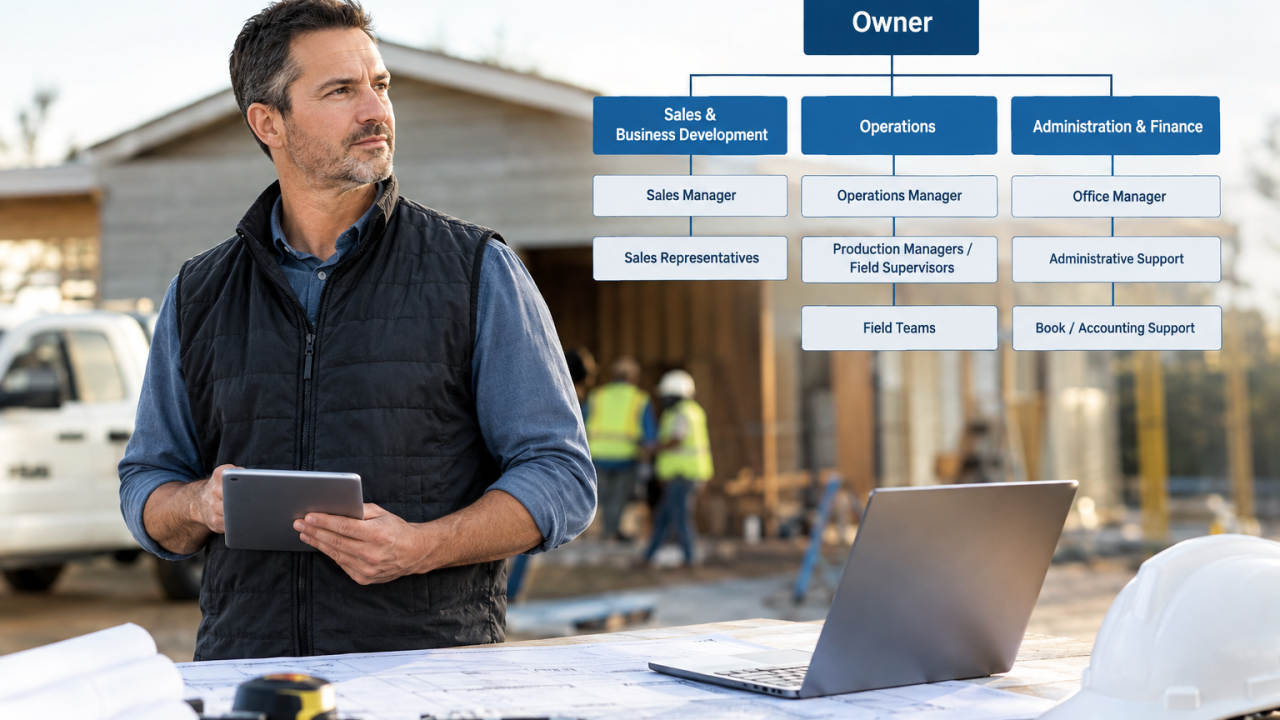
A more developed organizational structure might look like this:
- Owner / CEO
- Sales & Business Development – Sales manager, sales representative(s)
- Operations – Operations manager, production managers, field supervisors, field teams
- Administration & Finance – Office manager, administrative support, bookkeeping and accounting support
In this structure, the sales manager oversees sales representatives, the operations manager directs production and field leadership, and the office manager coordinates administrative support. Bookkeeping and accounting may be handled internally or outsourced.
The owner focuses on leading the organization, developing its leaders, monitoring overall performance, and setting strategic direction rather than managing every employee directly.
Not every contractor needs every position at this revenue level. Some roles may be combined or outsourced, while others may need to be added as workload and operational complexity increase. These structures are illustrative, not universal templates. The right structure depends on factors such as the number of crews, types of projects, administrative workload, and overall operational complexity.
The objective is to ensure that each critical function has clear ownership, appropriate authority, and sufficient leadership capacity.
The goal is to move from managing everyone directly to leading people who can effectively manage their areas of responsibility.
Four Organizational Structure Mistakes Contractors Make
Even when contractors recognize the need for more structure, four common mistakes can undermine their efforts.
1. Everyone Still Reports to the Owner
When every employee reports directly to the owner, questions, decisions, and problems quickly become unmanageable. The owner becomes a bottleneck, slowing the entire organization.
2. Promoting People Without Defining Their Roles
A strong technician may be an excellent candidate for leadership, but technical ability alone doesn't guarantee management success. New leaders need defined responsibilities, decision-making authority, training, and clear performance expectations.
3. Waiting Too Long to Add Leadership Capacity
Many owners wait until they are overwhelmed before creating a leadership position. By then, communication may be breaking down, employees may be frustrated, and the owner may have little time to develop the new leader.
4. Assigning Titles Without Accountability
A management title doesn't automatically create effective leadership. Every leadership role needs clear ownership, appropriate authority, measurable expectations, and accountability for results.
The common thread is that adding people or titles doesn't solve an organizational problem unless responsibilities, authority, and accountability are clearly defined.
When should you add an operations manager for your construction business?
For many growing contractors, hiring an Operations Manager can be a critical step toward reducing their dependence on the owner.
Consider whether:
- You still manage daily scheduling and production.
- Most customer or jobsite problems come directly to you.
- Field supervisors struggle to coordinate work or hold teams accountable.
- Project results are inconsistent.
- You cannot step away from daily operations without the business slowing down.
If several of these situations sound familiar, your business may need stronger operational leadership.
An operations manager should do more than handle daily problems. The role should coordinate resources, establish operational consistency, develop field leadership, improve processes, and ensure work is completed according to expectations.
The purpose is to build an operation that can function effectively without constant owner intervention.
The right time to add leadership is when the business needs the capacity—not simply when it reaches a particular revenue number.
Is Your Organizational Structure Ready for the Next Stage of Business Growth?
Many contractors assume that growing their business means hiring more employees. But adding people without strengthening the organization's structure can create more complexity, communication challenges, and demands on the owner.
Sustainable growth requires both the right people and an organizational structure that allows them to perform effectively.
At Precision SME, our organizational alignment services help you clarify who owns each area of the business, which decisions they can make, and how everyone works together. We work alongside you to put that structure into practice so fewer day-to-day decisions depend on you.
If your business is becoming increasingly dependent on you, it may be time to examine whether your current organizational structure can support the next stage of growth.
The question isn't simply how many more people you need to hire.
It's whether you have the organizational capacity to grow the business you want to build.