


Growth Is Often the Problem You Worked Hard to Create
Most business owners dream about growth. More customers. More revenue. More employees. More opportunities. More market share.
Growth is often viewed as the ultimate measure of success—and for good reason. It creates opportunity, expands what's possible, and validates that the market values what your business provides. But growth also creates something else...
Complexity.
If that complexity isn't managed properly, growth can create chaos faster than most business owners expect.
Many of the problems organizations experience during periods of growth are not signs of failure. They're signs that the business has outgrown the systems that once supported it.
The Growth Paradox
One of the most frustrating realities for business owners is this:
The more successful the business becomes, the harder it often becomes to manage.
Revenue increases, but so do operational challenges. Employees are added, yet communication becomes more difficult. Customers multiply, but maintaining consistent service becomes harder.
As the business grows, many owners actually feel less in control than ever before. This is the Growth Paradox.
Success creates complexity. Complexity creates challenges. Those challenges require the organization to evolve.
Why Small Businesses Feel Simpler
In the early stages of growth, most businesses operate with a relatively simple structure. The owner knows everything, communication happens naturally, decisions are made quickly, and problems are solved as they arise.
Employees wear multiple hats, processes remain informal, and the business depends far more on people than systems. At this stage, flexibility often feels like a competitive advantage. The problem is that what works with five employees often fails with twenty. What works with twenty employees often fails with fifty.
As organizations grow, complexity grows with them.
Growth Multiplies Everything
One of the most important concepts business owners should understand is that growth amplifies existing conditions.
If communication is weak, growth makes communication weaker. If accountability is inconsistent, growth makes accountability more difficult. If processes are inefficient, growth makes inefficiency more expensive. If leadership is underdeveloped, growth exposes those gaps.
Growth doesn't create most organizational problems.
It reveals them.
And once they're exposed, it usually magnifies them.
The Five Forms of Chaos Growth Creates
Every organization is different, but growth tends to create chaos in several predictable ways.
1. Communication Becomes More Difficult
Communication that once happened naturally begins breaking down as more people, departments, and projects are added. Information gets lost, teams become disconnected, and employees begin receiving inconsistent messages.
The informal communication methods that worked during the startup phase eventually become inadequate.
Organizations need communication systems—not just conversations.
2. Decision-Making Slows Down
As complexity increases, more decisions need to be made. Unfortunately, many organizations continue routing nearly every important decision through the owner.
Questions pile up. Approvals are delayed. Managers hesitate because they're waiting for direction, and employees sit idle while decisions work their way through the bottleneck.
The organization slows because the owner becomes the constraint.
3. Accountability Becomes Unclear
In smaller organizations, responsibility is usually obvious. Everyone knows who owns what.
As the business grows, responsibilities begin to overlap. Departments emerge, leadership layers are added, and without clearly defined roles, accountability becomes increasingly difficult.
People begin asking:
- Who owns this?
- Who makes this decision?
- Who's responsible for the follow-up?
Confusion replaces clarity.
4. Processes Become Inconsistent
Growth introduces variation.
New employees join the company. New services are added. New markets are entered. Without standardized processes, everyone begins performing work differently.
Customer experiences become inconsistent. Quality varies from one employee to the next, profitability becomes less predictable, and organizational alignment begins to erode.
5. Leadership Capacity Gets Exposed
Perhaps the greatest challenge growth creates is increased demand for leadership.
More employees require more coaching. More departments require more coordination. Greater complexity requires better decision-making.
Many organizations grow faster than their leadership capability.
Eventually, leadership—not sales, marketing, or operations—becomes the limiting factor.
The Warning Signs of Growth Chaos
Most growing organizations experience many of the same symptoms.
The Owner Is Working More Than Ever
Revenue may be increasing, but so is stress. Instead of stepping back, the owner becomes involved in more decisions, more problems, and more day-to-day issues.
Managers Feel Overwhelmed
Rather than leading proactively, managers spend most of their time reacting to problems as they arise. They rarely have time to improve the business because they're constantly trying to keep up with it.
Communication Problems Increase
The same conversations happen repeatedly because important information never reaches the right people. Details get lost, expectations become unclear, and mistakes become more common.
Customer Complaints Rise
As processes become less consistent, so does the customer experience. Service quality becomes harder to maintain, even though everyone is working harder than ever.
Profitability Stalls
Revenue continues to grow, but brofit doesn't.
The business becomes busier without becoming better. These are often signs that the organization has outgrown its current systems.
Why Working Harder Doesn't Solve the Problem
When growth creates chaos, many business owners respond the only way they know how. They work longer hours. They become more involved. They attend more meetings, oversee more work, and try to solve more problems personally.
That approach may provide temporary relief, but it rarely creates lasting improvement. Why? Because growth problems are usually system problems—not effort problems.
The organization doesn't need more heroics. It needs more capacity. Capacity comes from stronger systems, better leadership, clearer structure, and continuous process improvement.
What Scalable Organizations Do Differently
Organizations that scale successfully understand an important principle:
Growth requires evolution.
As complexity increases, they intentionally invest in the capabilities needed to support it. Rather than reacting to problems, they strengthen the organization before those problems become limiting.
That investment typically includes:
- Leadership Development – Building capable leaders throughout the organization.
- Organizational Structure – Defining clear roles, responsibilities, and accountability.
- Standardized Processes – Reducing variation while improving consistency.
- KPI Visibility – Creating transparency around performance.
- Continuous Improvement – Identifying and eliminating obstacles before they slow growth.
- Communication Systems – Keeping departments and teams aligned as the business expands.
These investments allow businesses to grow without allowing complexity to turn into chaos.
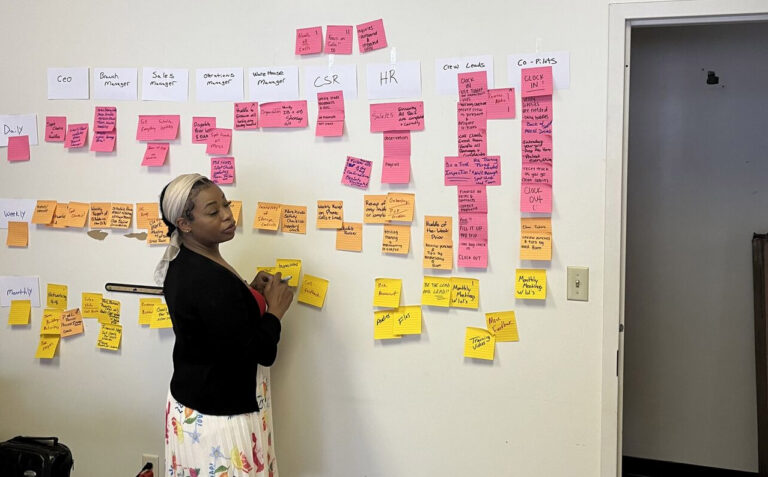
Helping a client make order out of chaos
The Real Goal Is Controlled Growth
Many business owners focus exclusively on growth. The better objective is scalable growth.
Growth that the organization can support. Growth that remains profitable. Growth that doesn't overwhelm leadership, employees, or systems. Growth that creates freedom instead of stress.
Controlled growth requires discipline. It requires planning, and it requires a willingness to evolve how the business operates as it becomes more complex.
The Business Impact
Organizations that successfully manage growth complexity often experience:
- Stronger profitability
- Better communication
- Improved accountability
- Greater operational consistency
- Stronger leadership teams
- Reduced owner dependency
- Better customer experiences
- Sustainable scalability
Most importantly, they maintain control as they grow.
Final Thoughts
Growth is exciting. It creates opportunity, rewards hard work, and validates that your business is delivering value. But growth also creates complexity. If leadership, structure, systems, and processes fail to evolve alongside that complexity, chaos becomes almost inevitable.
The businesses that thrive over the long term understand that growth alone isn't the objective. The goal is building an organization that's capable of supporting growth. Because the greatest threat to a growing business isn't a lack of opportunity.
It's a lack of organizational capacity. The organizations that scale successfully don't simply become bigger.
They become stronger.
And that's what makes sustainable growth possible.